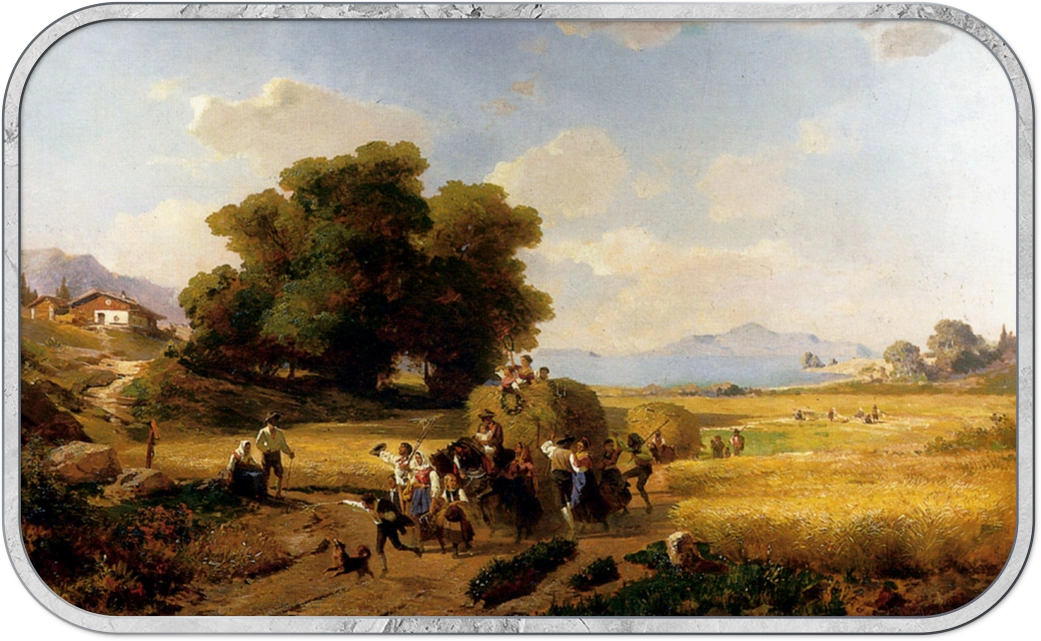
When I first started researching the last sheaf I always pictured a farmer on his tractor and it made it hard to understand what they were talking about. I imagined him driving up and down the field until he reached the final patch of grain, which made the whole idea of singling out the “last sheaf” seem really arbitrary. A sheaf, for anyone else who has never had much reason to think about this, is a bundle of cut grain tied together after harvesting. It feels pretty stupid now that I didn’t think of that right away but yes, farming looked a lot different before combine harvesters. There would be a bunch of people out in the fields at once. Some were cutting with sickles or scythes while others were gathering the stalks and tying them into sheaves. On a larger farm the work might involve family, servants, hired workers as well as neighbours. The last sheaf was not necessarily sitting at the far end of the field either (that’s what I pictured in the beginning. I thought it was the last row the tractor mowed down. I guess I also didn’t understand what a sheaf was at that time. Maybe I should have started with that) It could come from whichever patch happened to be the last one still standing.
Eventually somebody cut the final stalks and bound the last sheaf. People took notice of who ended up last. Whoever finished up last could be teased or given a special name. In the nineteenth century, the Upper Austrian folklore collector, Amand Baumgarten, recorded a particularly unpleasant belief about it. According to his notes, a married person who cut the last sheaf would die within the year. There is no story explaining this. Baumgarten just lists it among other signs that were supposed to foretell death. It might be one of those things where nobody knows anymore why it is the way it is.
There is also a very different custom associated with the last grain. In the Oberpustertal, workers were said to kneel around it and pray. This final bundle was called the Betgarbe, the prayer sheaf. In some parts of the country the last sheaf could also be given to a poor person or to someone connected with the church.
Sometimes a few stalks were simply left standing. Collections of German-speaking harvest customs mention various possible recipients for them. They might be left for witches, for the Kornfrau (Grain Woman) or in some places for the Bilwiss or Bilmeschneider.
THE BILWISS IN THE GRAIN
The Bilwiss is one of those figures that gets harder to define the further back you go. The name appears in different forms and the stories around it changed over time. In Bavaria, though, the Bilwiss or Bilmeschneider as they also call him could be understood as a corn demon that damages the grain. Bavarian dialect sources describe him as something that moved through fields at night, sometimes riding a black goat, with a sickle attached to his foot. The narrow strips of damaged grain left behind were known as the Bilwisschnitt/Bilmesschnitt. In some stories the Bilwiss did more than just destroy the crop. The grain would end up with him or with the farmer that enlisted his help. It was not always visable right away either. The farmer would bring in his harvest and after the work was done he would realize the yield is not as big as it was supposed to be. The missing part was said to have been gone to the Bilwiss.
People had ways of trying to keep him away. One of the stranger ones was the Bilmesschuss. In parts of Bavaria, farmers went out before sunrise on Pentecost morning and fired a gun over the fields to drive the Bilmesschneider off. They could also use juniper during threshing or the fields could be blessed as protection against the Bilwiss. The Bilwiss was not just something people told stories about. If you believed he could come through the field and take part of the harvest with him, there were actual things you could do to try to stop it. In some places, a few of the last standing stalks at the end of harvest were deliberately left for him.
This is not the only strange thing people did when it comes to the last bit of the harvest. This is a good point to introduce you to the Habergeiß.
THE HABERGEIß
In Upper Austria, the Habergeiß turns up in harvest customs connected with being last. She is usually described as some kind of goat-like figure but that only gets you so far. There was never one standard Habergeiß. Depending on the place and the custom, she might be something you heard crying outside in the fields, a strange animal figure in a procession, or a creature made from straw. For what we are talking about right now, harvest customs, it’s the one out of straw that matters.
The customs around her are described as Rügebräuche, which basically translates to customs of reprimand or ridicule. If a farmer was the last in the area to bring in his grain, his neighbours would make a Habergeiß out of straw and put it in his field. Everyone could see that the other farms were finished and he was not.
The problem, if you are trying to work out what exactly the Habergeiß was supposed to be, is that the straw figure is only one version of her. People also talked about hearing the Habergeiß outside at night, crying or bleating somewhere in the fields. Descriptions can get really odd. Some versions have wings while others have three legs. Then there are some where she has long horns, a goat-like head and a bird-like body. As if tha was not already confusing enough she then starts turning up outside the harvest season.
THE HABERGEISS IN WINTER
When the Habergeiß appears in winter customs, she usually does so as a masked or constructed procession figure. In parts of Upper Austria she still comes with the Nikolaus and Krampus but she used to also turn up during the Rauhnächte (the winter nights around Christmas and New Year) or at Fasching (carnival).
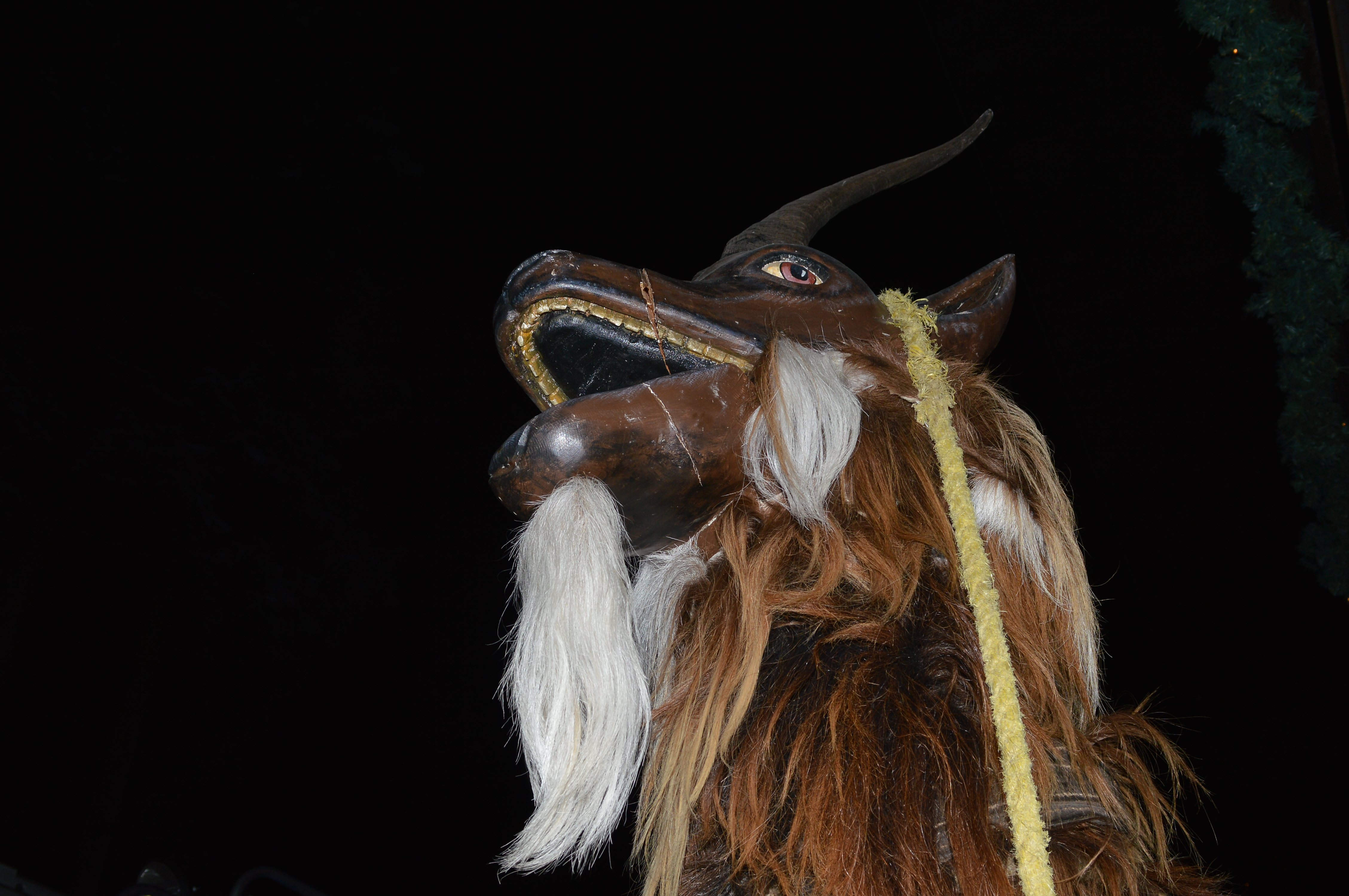 What this Habergeiß actually looks like depends very much on the village. Some are made from animal skins with a goat-like head and a jaw that can snap open and shut. Others are carried or operated by people hidden underneath them. In Lambrechten, they even lead a living goat in the procession. She can also be frightening because she is jumping around during the processions to scare children into behaving.
The Habergeiß is difficult to fit into one neat category. In one place she is a straw figure put in the field to mock the farmer who finished last while somewhere else she is a strange animal heard crying at night. Then winter comes and she is suddenly walking through the village with Nikolaus and Krampus.
We drifted off into winter following the Habergeiß but now back to the end of harvest season. Summer was also coming to an end higher up in the mountains. The cattle and herders were getting ready to leave the Alm and come back down to the valley.
The cattle comes home
The Almabtrieb is the autumn return of cattle from the Alm, the high summer pastures. It usually takes place sometime between September and October, depending on the region, the weather and how high up the pasture is.
The Almabtrieb is still a big fanfare today. The cows are beautifully decorated with huge bells, flowers, branches, ribbons and elaborate headpieces. The are not simply put on because somebody thought the cows looked nicer that way. If the summer had passed without the loss of a person or animal, the herd would be decorated for the journey home. Some of the animals carried particularly elaborate headpieces with mirrors worked into them.
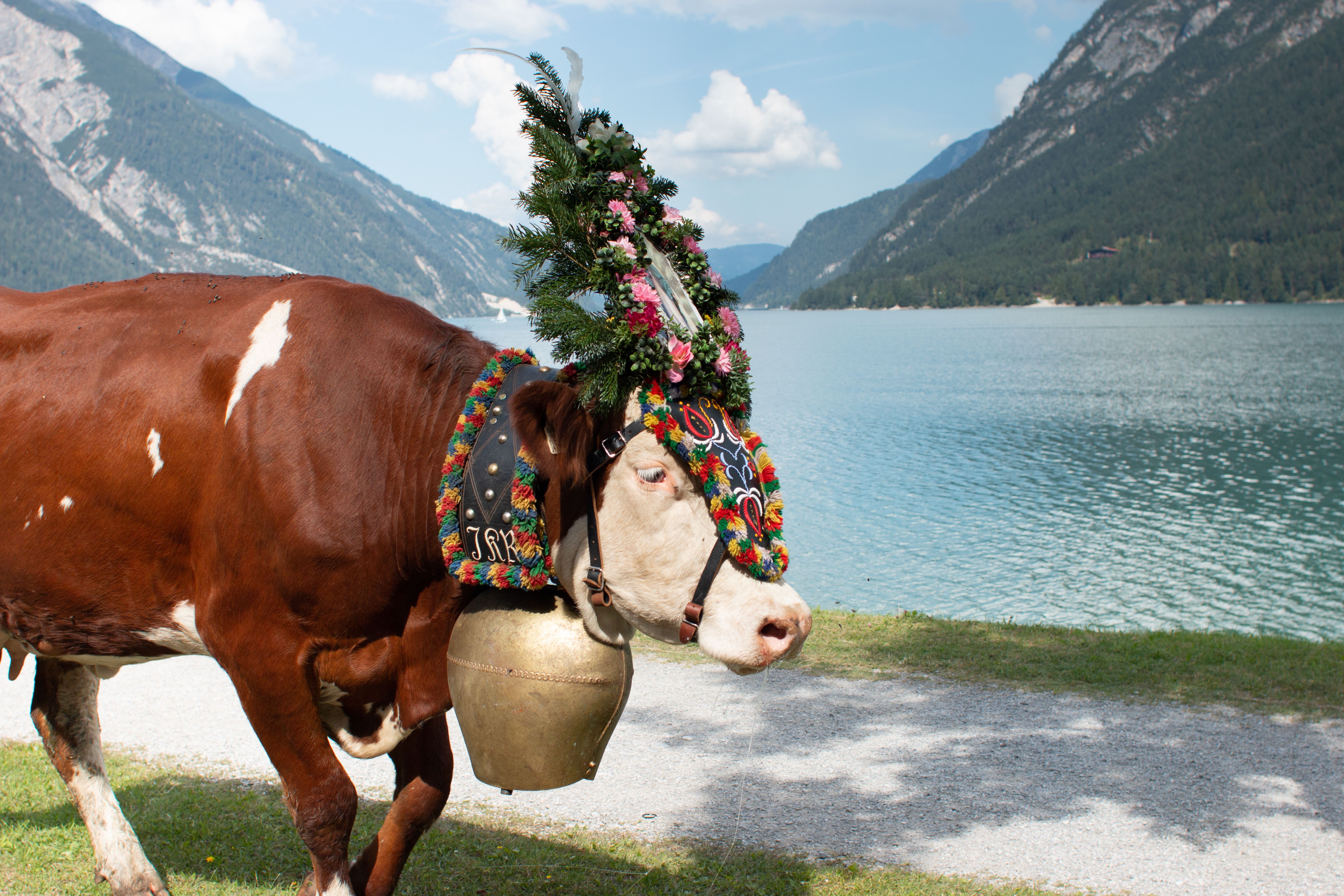
The bells were said to drive away harmful spirits and the mirror was there so something evil approaching the herd would see its own reflection and recoil from it. That did not quite make sense to me, though. If the decorations were meant to protect the animals, why would you leave them off after a summer in which somebody had actually died? Wouldn’t that be exactly when you wanted the extra protection? When I showed this part to Jesse, he had the opposite reaction. To him, leaving the decorations off after a death made perfect sense because whatever dangerous force you were protecting the herd from had already taken something, so perhaps there was no longer anything to ward off. I did some more digging, and it turns out some modern folklorists tend to lean towards the idea that the decorations were not originally meant for protection. But the mirrors especially still make me think there may be something to it. Because seriously, why put mirrors on the headpieces?
So while the grain harvest was finishing below, the cattle were also starting to come down from the mountains. Life was moving back toward the house and the barn.
The Kasmandl
In the Salzburg Lungau, people told stories about a small grey mountain being, that they called Kasmandl. It moves into the deserted Alm huts once the cattle and herders have gone back down to the valley. After the herders and cattle have left, the Kasmandl moves into the empty huts and gathers whatever the herders had lost or left behind. It would live on these remains through the winter. The story is still remembered in the Lungau today. On the evening before St Martin’s Day, children dress up as Kasmandln and go from house to house, reciting verses, singing songs and handing out Rahmkoch and Schnuraus (traditional sweets).
MICHAEL LIghts THE LAMP
By late September, you could also start to see the changes indoors. Michaeli, or Michaelmas, falls on 29 September and was once an important seasonal marker in Upper Austria. There is an old Upper Austrian saying I particularly like:
Da Michl zündet's Liacht an.
Michael lights the lamp.
During summer, craftsmen could work late into the day using natural light. After Michaeli, the evenings were becoming dark enough that the lamps had to come out again. In Bad Ischl, the first Monday after Michaeli became known as Liachtbratlmontag . Liacht means light, Bratl is a roast, and Montag is Monday. Traditionally, the master paid for a roast for his workers when the dark time of the year started.
Michaeli marked other important changes as well. This was the time where employment agreements often ended and began, payments were often due and a lot of markets were held. The women also started to gather again in the evenings in order to spin together. There were a lot of stories, gossip and everyone was in each other's business again.
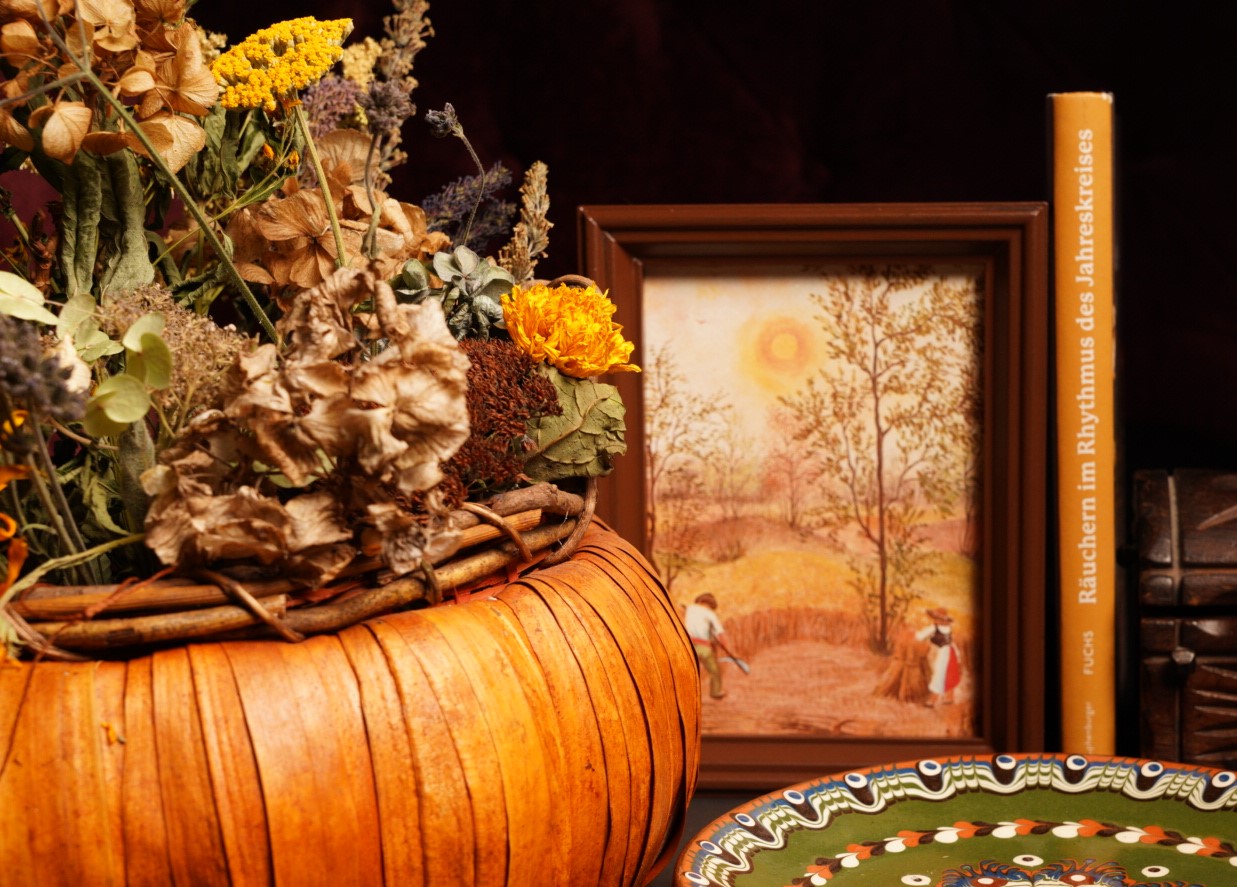
By this point in the year, very little remained of the summer world we began with. The grain had been cut and bound, including the final sheaf that nobody necessarily wanted to be responsible for. Somewhere a straw Habergeiß is sitting out on a field of a farmer whose neighbours had beaten him to the end of the harvest, while elsewhere a few stalks were left standing for the Bilwiss. The cattle came down from the Alm, and the work that had filled the long summer days was beginning to move indoors.
Sources
- Hörmann, Ludwig von. Das Tiroler Bauernjahr: Jahreszeiten in den Alpen. Innsbruck, 1899.
- Burgstaller, Ernst. “Rügebräuche bei der Ernte in Oberösterreich.” Zeitschrift für Volkskunde 52, 1955, pp. 205–221.
- Keller, Irene and Christian. “Die Habergeiß.” In: Glaube? Aberglaube? – Volksfrömmigkeit. Forum OÖ Geschichte.
- Heitzmann, Anton and Josefine. “Kasmandl.” Lungauer Volkskultur.
- Tirol Werbung. “Almabtriebe: Geschichte einer Tiroler Tradition.” Presse.Tirol, 31 July 2026. Pictures from top to bottom:
- Franz Richard Unterberger. The Last Day of the Harvest (Letzter Erntetag), c. 1859. Oil painting. Public domain. Via Wikimedia Commons.
- Wald1siedel. Goldegger Perchtenlauf 07, Goldegg im Pongau, Salzburg, Austria, 1 January 2015. Photograph. CC BY-SA 4.0. Via Wikimedia Commons.
- Holger Rockenmayer. “Decorated cow at the Almabtrieb festival near Achensee, Tyrol, Austria.” Pexels. Pexels License.