When meditation is mastered, the mind is unwavering like the flame of a lamp in a windless place.
~ The Bhagavad Gita 6:19 ~
When meditating, one must always assume a seated full (or half) lotus posture, with the spine perfectly upright and stacked. Next, the mind must be perfectly cleared in a very specific way, and the practitioner should focus entirely on their breath, which must be carefully timed and performed in accordance with the prescribed method. If you accidentally fall asleep or drift off, you have done it incorrectly. If your posture is flawed, or you attempted to meditate in some other position, you are wrong. If your breath was not as smooth and strong as the silk of the golden orb spider, or your thoughts wandered, you should probably give up on meditating in general.
A Golden Orb-Weaver

This spider is well known for its extremely strong silk possessing a golden sheen.
Ok, so that is maybe a little bit of an exaggeration, but I'll bet it isn't that far off from what you might have come across while trying to learn about meditation and how to begin practicing. Most instructions seem to come across as vague and unclear while simultaneously somehow being weirdly specific about what you are allowed and not allowed to do when practicing. And often more than a little gatekeepy about it. At least that is how it seemed to me when I first tried to learn a long time ago. The result was that I found it uncomfortable, boring, and kind of a waste of time and effort. Even sitting for just 10 minutes, frequently one of my legs would begin to fall asleep or some other spot(s) would become uncomfortable to the point that it was impossible to focus on anything else. I began to wonder if this just wasn't something I'd ever be good at or really like. I tried to stick to a routine of following the standard advice and the only thing I discovered was a way to feel like I was doing work I didn't like for results I wasn't getting. I had a hard time believing that anyone was really getting value from meditation, and thought it was maybe something a lot of people did just to check a box on the list of things that one does in order to have a personal spiritual/mental practice. And I still suspect many do practice in a very conventional, "this is how one meditates properly" way, like they are grinding for experience points in an RPG, while experiencing little real progress or discovery.
Why is it this way?
Many skills can be observed. When a musician starts playing, it soon becomes apparent whether or not they've got chops earned through many hours of practice, or if they are still a beginner. When we see the artwork of an experienced painter, it's easy to know if they are at least pretty good at what they are doing. No one can fake cleanly performing difficult yoga poses, or running a marathon. With meditation it is not so, the crowns of devoted, consistent practice can be fully appreciated only by the practitioner who wears them, remaining hidden from the open acknowledgement of others. This also makes it very difficult to truly understand what you should be experiencing through your practice. And whether the source you learn from has that experience or not. Why trust me? You shouldn't. My suggestion is read the article, then try for yourself, and find out if there is value here for you. But if it helps, my thoughts come from over 15 years of practice and experimentation. They are not just a tired rehash of what others have said.
So how does it happen that standard conventions become so firmly established and rarely deviated from? There's an old allegory that suits the situation, as it does many others in modern society.
The Five Monkeys
Five monkeys are placed in a room with a ladder in the center. Above the top of the ladder hangs a bunch of bananas.
Soon, one monkey tries to climb the ladder, and when he does, all five monkeys are sprayed with water from something like a fire hose that packs a punch in addition to being cold and wet. Later, another monkey goes for the bananas. All get hit with the hose again. The monkeys stop attempting to climb the ladder.
Then one monkey is replaced. The new monkey sees the bananas and tries to climb. Immediately, the others attack him, pulling him down and beating him in time to keep from getting hosed. The beaten monkey doesn't understand why, but he doesn't try to climb again.
One by one, the original monkeys are replaced. Eventually, none of the monkeys in the room have ever been sprayed with water. Still, if a monkey reaches for the ladder, the others stop him.
No one remembers the punishment anymore. No one knows where the rule came from. But the rule remains; no one questions, and none dare to challenge it.
To be clear, I don't think that the standard advice is arbitrary and devoid of meaning. But it is worthwhile to consider how often people understand the spirit and principles behind such guidance, and how often it is followed and passed on blindly and habitually. I believe its original purpose was to provide a simple introduction to what might be useful and how we can start to seek, not to create a set of invisible walls confining meditation.
Some Alternate Methods
The Conventional Standard
For comparison's sake, let's see a quick overview of the conventional meditation method commonly taught.
The Standard Way
1. Sit upright, either in a chair or on a cushion cross-legged.
2. Keep the spine upright and aligned, but not rigid or tense.
3. Rest hands in the lap or on the knees.
4. Breathe naturally, paying attention to the breath as a place to direct focus.
5. When the mind wanders, gently return attention to the breath.
6. Continue this process for the remainder of the session.
While many sources repeat the same methods and advice, there are other forms of meditation that have existed for centuries, but are less frequently discussed. Let's take a look at two such examples.
A Moving Example
Some methods of meditation are even done while in motion, and are therefore referred to as moving meditation. A little known example of this is a meditative ritual practiced by Daoist monks of the Quánzhēn (roughly pronounced "chwen-jun" and meaning "complete perfection") school in China by the end of the 18th century. The practice, called zhuǎn tiānzūn (roughly "jwan tyen-dzoon"), involved walking along a circular path while focusing the mind by repeating an invocation. The practice was performed as part of both the morning and evening liturgies.
Zhuǎn Tiānzūn
The circling rite is introduced with the following verse:
人心皆散亂,一念便純真。
(Rénxīn jiē sànluàn, yī niàn biàn chúnzhēn.)
欲求無上道,大眾轉天尊。
(Yù qiú wúshàng dào, dàzhòng zhuǎn tiānzūn.)
This can be approximately translated as:
The human mind is scattered. Through one thought it becomes pure and true.
To seek the highest Dao, the assembly performs zhuan tianzun.
The monks would then walk slowly around a circular route, with an emphasis placed upon smooth and balanced motion while maintaining a focused mind. This promoted a state of stillness in motion.
While walking the circle in the morning the monks would repeat:
九天應元雷聲普化天尊
(Jiǔtiān Yìngyuán Léishēng Pǔhuà Tiānzūn)
This is the formal title of the Daoist thunder deity, associated with cosmic order, transformation, and the dispelling of harmful influences.
And during the evening ritual the invocation was:
太乙救苦天尊
(Tàiyǐ Jiùkǔ Tiānzūn)
This is the title of the deity associated with deliverance from suffering and the salvation of wandering souls.
Upon completing three circuits, they would cross through the center along an 'S' shaped path, and in so doing, reverse direction. The diagram below shows the walking path of the direction change, resembling a taijitu (yin yang symbol).
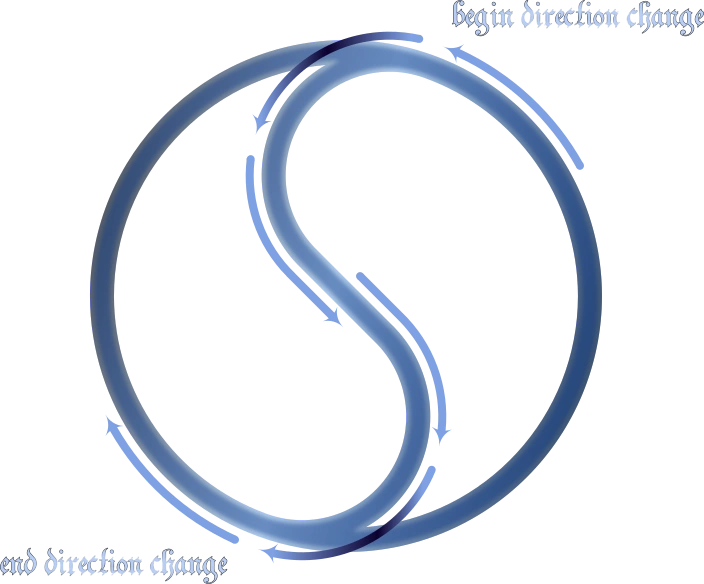
Thus, the recitation served as a devotional act and as a means of focusing the mind through its repetition in combination with walking along the circle. It is believed that Dǒng Hǎichuān adapted this practice to create circle walking, the foundational practice of Bāguàzhǎng, one of China’s three major internal martial arts alongside Tàijíquán (better known in the West as Tai Chi) and Xíngyìquán. And while Baguazhang's more martial circle walking differs significantly, as a practitioner I can say it definitely has a meditative, self-hypnotic nature.
A Lying Down Example
On the other end of the spectrum we have Yoga Nidrā (roughly "yo-guh nid-ruh"), approximately meaning "yogic sleep". This meditative practice is performed while lying flat on the back. Instead of maintaining an upright posture, the practitioner allows the body to become deeply relaxed while trying to maintain awareness. While lying down meditation has much older precedents within yogic tradition, the form commonly practiced today was systematized and made popular during the twentieth century, particularly through the teachings of Swami Satyananda Saraswati. Below we see the main ideas involved.
During the practice of yoga nidra, one appears to be asleep, but the consciousness is functioning at a deeper level of awareness. For this reason, yoga nidra is often referred to as psychic sleep or deep relaxation with inner awareness.
~ Swāmī Satyānanda ~
Yoga Nidrā
In Sanskrit: योगनिद्रा
1. Lie as still as possible. Typically in śavāsana (on the back with legs comfortably apart, arms slightly away from the body, and palms facing upward).
2. Establish a sankalpa, a short personal resolve or intention.
3. Move attention through the body, bringing awareness to different body parts without moving them.
4. Continue with breath, sensations or imagery, experiencing sensations of heaviness or lightness, heat or cold.
5. Allow yourself to move toward deep relaxation, even a sleep-like state, while maintaining awareness.
We could summarize the sequence as:
Settle the body → rotate awareness through the body → observe the breath → experience sensations or imagery → gradually return
An important takeaway from Yoga Nidra is that lying down and moving into a sleep like state are not concessions made solely to increase comfort, but are in fact intentional and desired parts of its method.
From these two examples we can see that not all legitimate practices follow the common rules, and that there are multiple ways to experience what meditation can offer.
Another Approach to Meditating in Lying Down Position
Long before I had heard about walking the circle or yoga nidra, I began exploring lying down meditation in response to my lack of success with conventional methods. I started experimenting with lying totally still and deeply relaxing. The shape that this practice developed into over time is not that far off from Yoga Nidra, but has some distinct differences. And since I will be giving a more detailed explanation of this practice, I don't want us to be confined by what is and is not technically Yoga Nidra. And even if you would prefer to pursue standard upright methods, this is a good starting place to get early wins with a low barrier to entry, and to not spend too much time overthinking correct posture or how to sit comfortably for longer periods. After practicing meditation for over 15 years, it's still my favorite way.
My Method
This is best done in a very comfortable spot. A bed is perfect. You can even practice before bed, or if you feel tired and want a few minutes to recharge during the day. I recommend setting a timer early on. It will help you practice for a reasonable amount of time and it's also helpful in case you fall asleep and need to be up afterward. Anywhere from 20 to 40 minutes is a good starting place. I usually practice between 30 and 50 minutes, but the desired time is up to you. Just keep in mind that it can take some time for really interesting things to start happening, especially before you understand what you are trying to do. Throughout the entire session, just breathe naturally in whatever way feels comfortable. I usually breathe through the nose into the abdomen, breathing through your mouth can dry it out quickly, but in through the nose and out through the mouth can work. I never had a name for this type of meditation, but Melanie always jokingly refers to it as 'ancestor contacting' so ... whatever ...
Ancestor Contacting
1. Get into position Begin lying on the back with legs comfortably apart, arms slightly away from the body, and palms facing downward (In my experience this makes it easier to fully relax the hands). I use a thin pillow to support the head.
2. Become completely still. Achieving complete and fully relaxed stillness for a prolonged time is important here, so take a few moments to make whatever minor adjustments you may feel the need to in order to become totally comfortable. Afterward, attempt to remain still, but if you soon feel a need to adjust you should do so, then return to stillness. Soon you should reach a point where you feel you can stop moving and stay that way.
3. Relax. Steadily relax more deeply, performing a scanning of various parts of the body and attempting to make them go limp and become heavy as if formed from dense stone, dissipating any feelings of tension or exertion. Remember to check the face and neck, we tend to carry significant tension in these spots without realizing it. If you find a spot difficult, start from the opposite. For example if you are not easily relaxing your face, take a breath in, then try opening your mouth and raising the eyebrows, creating tension, then release the tension as you exhale and move into a relaxed state. Using that momentum can help to reach a deeper release of the tension. Notice the effect of relaxing on the exhales. Exhaling is a relaxing process by nature, and can help to guide the rest of your body and mind.
4. Explore. Once you have maintained a still, deeply relaxed but aware state for enough time, interesting things can begin to happen. You may lose clear feeling of where your body ends and the space around it begins, it also might feel expanded and less dense. In this state you should explore whatever creative ideas you may have. Can you feel your blood flowing? Are you able to direct more strongly to specific areas? Can you slow your heart rate? How about your mind and sense of self? What might you do with it once its bond to the body seems less definite? Take your time and follow your curiosity. The exploration is the goal. And if your experience doesn't exactly follow what I or anyone else describe, that's ok. It's your show. Forcing things is counterproductive.
Remember, if you drift off that's ok, just as Yoga Nidra suggests, some of the most interesting things happen right on the threshold between consciousness and unconsciousness, and exploring them will sometimes mean falling asleep, even if that isn't necessarily the goal. Sometimes I found that drifting into a short sleep this way, even though it tends to be short, can feel like it was more refreshing and energy restoring than expected.
So What is the Correct Way to Meditate?
I've been hard on conventional wisdom and teaching in this discussion, but there is a reason it is so conventional and its tenets so frequently repeated. The point is to try and understand the spirit of the rules, and the underlying concepts that are valuable, not to hold them up as unbreakable law carved into metal. We should try to find the value in the standard practices, what about them works and why. Understanding the foundations and principles that inspired the rules is what will make it possible to not need them. And by trying methods that appear very different on the surface, we can begin to find the common threads that really form the heart of meditation.
The correct way to meditate is the way that provides something meaningful to you. That lets you explore and discover whatever draws you. Some days nothing interesting will happen. Others will surprise you in ways neither of us can guess. With meditation the journey is the destination. The process is what will matter, that you attain one more small joy that exists within, entirely untouchable from the outside. No one will be able to see if you're really doing it, and you're never going to be able to show off with it. So do your best to see that you are getting something worth showing up for.
Sources
- Lai, Chi Tim. Daoist Liturgy of the Most High for Daily Recitation. Hong Kong: The Chinese University of Hong Kong Press. Read the translator's introduction .
- Taishang Xuanmen Gongke (太上玄門功課). Daoist morning and evening liturgical text, including the Zhuan Tianzun (轉天尊) passage. Chinese Text Project. Read online .
- Miller, Dan. “The Circle Walk Practice of Ba Gua Zhang.” Pa Kua Chang Journal, Vol. 4, No. 6, September–October 1994. Read the scanned issue .
- Birch, Jason, and Jacqueline Hargreaves. Yoganidrā: An Understanding of the History and Context. The Luminescent, 2015. Read online .
- Saraswati, Swami Satyananda. Yoga Nidra. Munger, Bihar: Bihar School of Yoga, 1976.