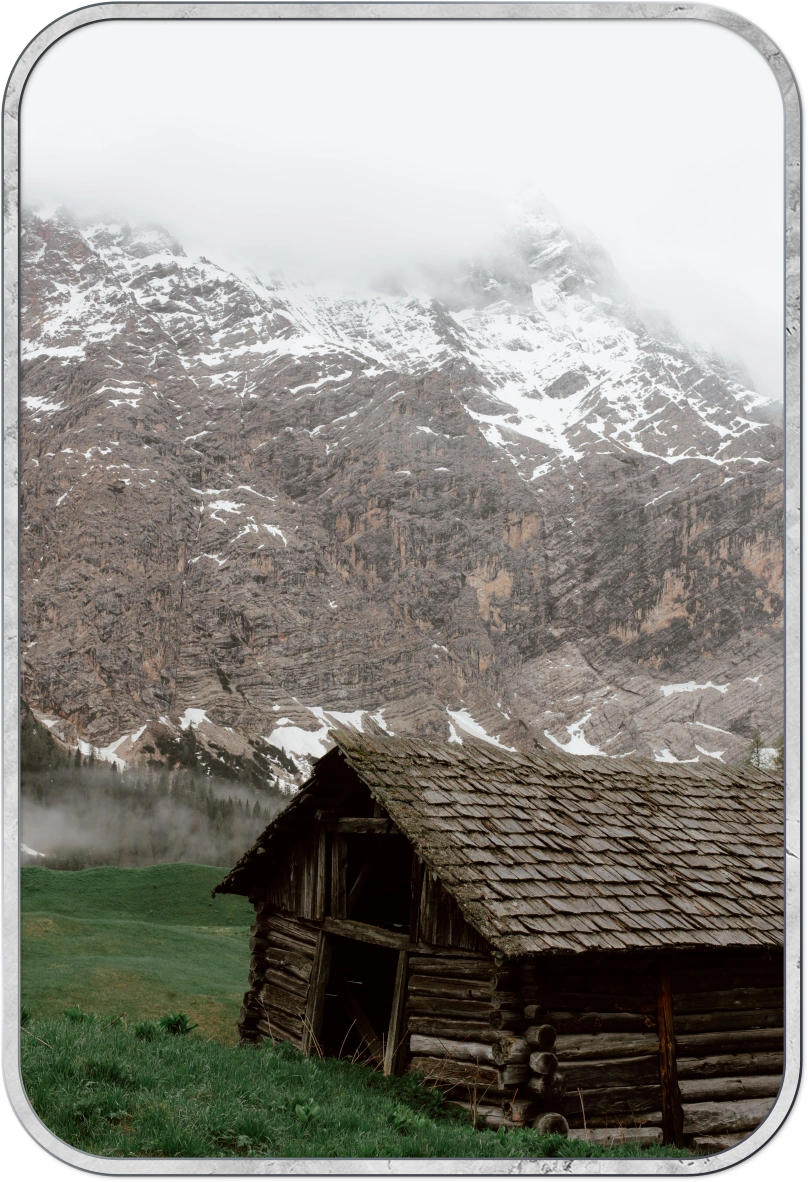
I was looking for an alpine folk horror story to share with you for spooky season. After some research, I came across one that ends with someone being skinned alive and the skin then spread across an alpine hut's roof. And yet, that's not really the scary part of the story. Especially if you are a woman. Keep reading. This gets a lot stranger than just a scary folklore story...
Let me tell you the story of Zurrimutzi
First, we are going to need a bit of background info.
- Senn = alpine dairyman/herdsman.
- Tuntschi = Swiss German dialect for doll or puppet.
So Sennentuntschi is basically the name given to a strange figure from alpine folklore: a doll made by herdsmen that eventually comes to life. The tale we will see belongs to a wider group of stories about the Sennentuntschi. The earliest known printed example of such a story dates to 1839 in Austria. And while there are many different versions of these stories, they all have a common theme. In each, a taboo is broken, and breaking it brings consequences. Some stories are about smaller transgressions such as wasting food or mocking religious rites. But there is also a distinctly sexual branch of the tradition, and within that branch, the details vary from one account to another. I’m going to tell you the Zurrimutzi story from Uri, but I’ll also pull in a few details from closely related versions. These stories were collected by the Catholic priest and folklorist Josef Müller in Uri, Switzerland, between 1903 and 1925. Side Note: Müller collected the oral tales in the early 1900s, but that does not mean that this story can’t be much older. People may have told it already for a long time before someone wrote it down.
Earlier we saw the term Senn. To elaborate, a Senn was the head dairyman, responsible for turning the milk into valuable products like cheese and butter. And during the summer, a Senn would have authority over the farmhands he worked beside, acting as the chief of the dairy operation. This would take place in higher mountain pastures for several reasons. The cows would have more variety in what they grazed making for better quality milk and cheese. Also, the higher pastures were a cooler environment with fewer insects, and more of the lower areas would remain available for growing crops. However, these advantages didn't come without downsides.
In such a remote place, totally isolated, the rules of society begin to feel like half-remembered suggestions. In general, alpine summer work had a reputation for being a different world. There were plenty of rumours about what went on when groups of men spent months up there together, apart from the rest of the world. I even read one account where someone said that he would never allow his young son to spend the summer in the alpine pastures, because of all the stories of heavy drinking and unwanted sexual advances by the often much older Senn towards the younger helpers.
A Folk Horror Story
One year, as the weather began to warm, a Senn and his two farmhands left their small village to take the cattle high up onto the alpine pastures. All three would spend the entire summer high up in the mountains taking care of the herd and producing dairy products. The Senn and the farmhands of our story worked all through the summer. It is easy to picture an idyllic scene of living full days high in the mountains, but the reality of it was hard physical labour, every day of the week. In the evenings the men would often unwind together by drinking and joking around. At some point during the summer, one of the men said that what they really needed up there was a woman. In their drunken stupor, the men had a "clever" idea to help alleviate their loneliness: they made a roughly human-sized doll from things like rags, old clothing, wood, and stuffing such as grass or moss. They even gave the doll a name. They called her Zurrimutzi. They started treating Zurrimutzi like a human for days. They would feed her, carry her around with them, and talk to her. Now that they had the doll they didn't feel so alone and everything worked out fine...
...as if that's how a story like this would end. Instead, the doll soon became an outlet for built up urges, and they used her as a sex object. As a woman this already seems quite weird and desperate to me, but hey, we don’t kink shame here. What follows, however, is where it goes off the deep end.
After treating Zurrimutzi like a human for a while, things started to get weird. One day, while the men were pretending to feed her, she opened her mouth and started eating the cheese for real. The men were scared at first, but also intrigued. Slowly the doll started to do more and more things. She started talking and walking. The men had Zurrimutzi cook and clean for them and, I am sure you know where this is going, they took turns taking advantage of her in the bedroom as well.
When the summer came to an end, the three men were happy to be returning home. As for Zurrimutzi, they created her during the summer, then used her during the summer. Now that summer had come to an end, there was no more need for her. So, they packed up and set out to leave, but on the way out ran into Zurrimutzi. She wasn't amused that they had intended to leave her behind on the mountain. She said to them:
I worked for you all summer. Now I am entitled to a pleasure of my own. I have to stay here, but one of you must stay with me, otherwise it will go badly for all of you.
The men drew lots and the Senn lost. Zurrimutzi told the other two to leave the mountain quickly and to not look back on their way down. The two young men didn’t waste any time. They ran down the hill, and right before the last turn, after which the hut could not be seen, they dared to look back. What they saw was terrible. Zurrimutzi was on the roof of the hut skinning the Senn alive. After she was done carving off his skin, she spread it across the roof. Shocked and terrified, the two ran down into the village as fast as they could.
To recap: These creeps made a sex doll out of dirty old rags, took turns banging it, and when it became conscious, they made her into their maid/sex slave over the summer. Then when they had something better to do, returning to their community, they just discarded her. They never had any plans for her after that summer. I doubt it even crossed their mind what would become of Zurrimutzi once the summer was over.
The Wider Sennentuntschi Tradition
As I mentioned in the beginning, this is only one version of the story. There are many versions that are not of a sexual nature at all. In these stories the men feed the doll, and that alone is the taboo that is being broken. Food was seen as very valuable back then, and wasting it on a stupid game was punished. In one account, this is made even clearer by introducing a beggar that passes by and asks for food. He is turned away, while later that day the inanimate doll is fed. Another branch of these Sennentuntschi stories involves a ‘mock baptism’ in which the men christen the doll with filthy water as a joke. All stories have something in common. The men think that while they are away from society and nobody is watching, they won't have to face any consequences for the things they do. They think that what happens in the mountains stays in the mountains. But as is a common theme in stories like this, the powers beyond human understanding seem to disagree. All of this would already be strange enough as folklore, but it just gets weirder.
The Doll from Masciadon
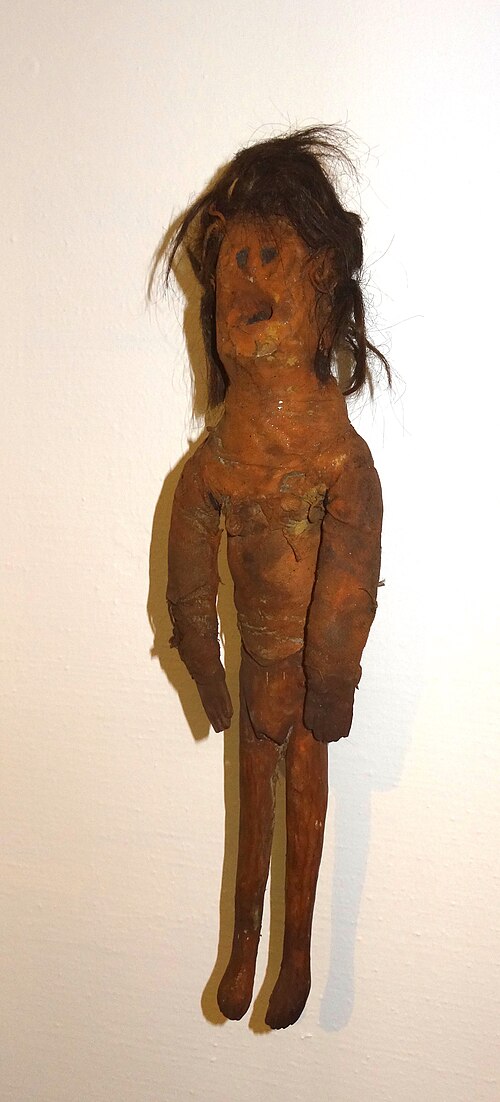
In 1978, the Swiss folklorist Peter Egloff was hiking in Masciadon in the Calanca Valley, Switzerland. Masciadon was a small, seasonal alpine settlement which, by the time Egloff happened upon it, was largely abandoned. The small, run-down huts were empty except for one, occupied by an old man who would spend spring and fall there, using it as a seasonal stop between the village and the high alpine pastures. The old man had a strange doll he found during renovations. Egloff was familiar with the Sennentuntschi folklore stories and immediately thought about them when he saw it. He bought the doll from the old man for around 20 francs. The man didn’t know much more about the doll, and Egloff’s research attempts in the area also did not come up with any more information. Egloff then donated the doll to a museum in 1986. The museum lists it as an undated wooden doll, often referred to as a “Sennentuntschi.” The doll is 40 cm tall, carved out of wood, dressed in some sort of clothing, and has human hair attached to it. It has a wide open mouth as well as a clearly visible vulva. We may never truly find out what this particular doll was used for and why it exists. Maybe it has nothing to do with the Sennentuntschi stories at all. But considering where it was found, what it looks like, and what kind of stories have been told for many generations, it’s hard not to look at it and wonder.
Sources
- Josef Müller, Sagen aus Uri, Band II (1929). Includes the Sennentuntschi tales collected in Uri, including Das Sennentunscheli auf Wyssenboden. German National Library
- Gotthilf Isler, Die Sennenpuppe: Eine Untersuchung über die religiöse Funktion einiger Alpensagen (1971). A major folkloric study of the Sennenpuppe tradition, including feeding, sexuality, mock baptism, animation and supernatural punishment.
- Peter Egloff, Der Sennentuntschi-Fund von Masciadon (1993). Egloff's account of the strange doll he found in the Calanca Valley in 1978 and its possible connection to the Sennentuntschi tradition. e-periodica
~ PICTURES FROM TOP TO BOTTOM ~
- Photo by eberhard grossgasteiger via Pexels
- Photo by Adrian Michael, via Wikimedia Commons , licensed under CC BY-SA 3.0 .