A Personal Beginning
When I think of summer, I think of the smell of blooming elderflowers. We had a lot of elder bushes around the garden when I was a kid, and somehow the scent of the white blossoms settled somewhere deep and stayed.
When I first came across the idea of “plant allies,” the elder was the first that came to mind. Maybe it was just those memories, but I like to think that something in the plant itself drew me back. So I started to learn more about it and quickly realized that it carries a long history and a lot of lore.
You can’t really talk about the elder tree without talking about Frau Holle.
Frau Holle and Her Many Faces
Most people know her from the stories collected by the Brothers Grimm. She is also known as Holda, Perchta, Berchta, or Percht.
In her quieter aspect, she resembles Frigg, associated with fate and household order. In her wilder forms, closer to Perchta, she carries something of Freyja’s untamed and death-bound nature.
~ Goldmarie and Pechmarie ~
Goldmarie, which translates to “Gold Mary,” is sitting on the edge of a well spinning when her spindle falls in. In order to get it back, she jumps in after it and finds herself in another world. It is bright and alive, not dark like you might expect.
As she wanders through this place, she comes across a bread oven. The bread calls out that it is ready and needs to be taken out before it burns, so she takes it out. A little further on, she reaches an apple tree. The apples ask to be shaken down because they are ripe, and she does that too.
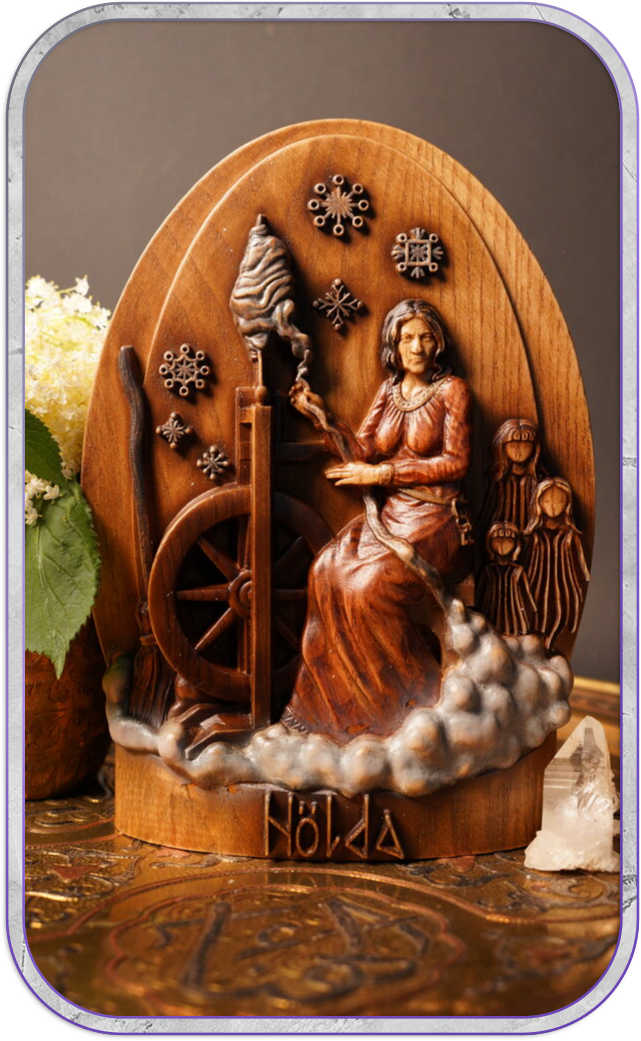
Eventually, she arrives at the house of Frau Holle, an old woman who seems to be the ruler of this world. Goldmarie stays with her and helps with the housework. She pays attention to what needs to be done and takes care of it. Part of her work is to shake out Frau Holle’s feather bed. When she does, the feathers fall down to the earth as snow.
After some time, Goldmarie wishes to return home. Before she leaves, Frau Holle gives her back the spindle she had lost.
As Goldmarie passes through the gate back into her world, she is covered in gold.
Later, her sister Pechmarie, which translates to “Pitch Mary,” tries to do the same, hoping for the same reward. She also enters Holle’s world, but she has no interest in the work. She ignores the bread, the apples, and everything else that needs to be done, and only thinks about the gold.
When she returns, she is covered in pitch instead.
Looking Beneath the Story
At first glance, the story seems to carry a simple moral. If you are lazy, you will be punished. But if you look a little closer, it is a lot deeper than that.
Goldmarie falls into the well. In older traditions, wells as well as lakes were often seen as entrances to the world of the dead. This realm is often described as bright and fertile, a green meadow full of life. In some traditions, it is imagined as a hidden world beneath the earth. At the same time, she loses her spindle. Spinning is often connected to the thread of life and fate.
The bread is ready and must be taken out at the right moment. The apples are ripe and need to be shaken from the tree. Nothing happens randomly. Everything has its time. Goldmarie responds to this. She does what needs to be done, when it needs to be done. She moves in rhythm with that world. Pechmarie does not. She ignores what is in front of her and only looks for the outcome.
When Goldmarie shakes Frau Holle’s feather bed and it begins to snow on earth, it shows that what happens in her realm is not separate from the natural world. In older beliefs, the dead were still present in the land and its cycles. Offerings to the ancestors were part of maintaining that connection.
Before Goldmarie leaves, Frau Holle gives her back the spindle. Spinning is often linked to the thread of life. When the spindle is lost, that connection is interrupted. In Holle’s realm it is set right again, and she returns with it.
The gold that falls over her can be seen as a reward, but it also reflects how she moved through that world. Goldmarie followed its rhythm and took part in it. Pechmarie did not. What they return with shows the difference.
Seen this way, the story is less about good and bad behavior and more about alignment. About whether you move with the order of things or against it. And Frau Holle stands at the center of it. She is not just a figure in a story, but something much older, something that connects the world of the living, the dead, and the forces of nature.
The story gives a glimpse of her, but it is not the whole picture.
Frau Holle and the Cycle of Life
Frau Holle is often described as a goddess of both death and birth.
As the fairytale already suggests, she is connected to the souls of the dead. The dead were thought to pass into her realm, and from that same place new life could emerge.
Women would go to places connected to her, wells, ponds, and lakes, and ask for a child. These places were seen as points where something could pass between worlds. In Germany there is a specific site, the Frau Holle pond on the Hoher Meißner, where women are said to have gone for this very reason.
She is often connected to both seeds and souls. Her role is not limited to human life and death, but extends to the cycles of nature as well. In nature, seeds lie hidden in the earth before they grow again, and life was understood in the same way.
Spinning and Fate
Holle is also one of the spinning goddesses, alongside figures like Frigg and Freyja. She is closely connected to women’s sphere of life. Spinning, caring for the household, birth, and the handling of the dead were traditionally part of women’s roles, and all of these are reflected in her.
Spinning used to be a central part of life, but it was never just a simple chore. The thread stood for life itself, something that continues, that can be shaped, and that can also be cut. To spin was to shape reality in a subtle way. The fate of a household, a family, was believed to be influenced by the women who spun and wove. Their thoughts mattered. Love, hope, and intention were said to be woven into the fabric itself.
The Elder Tree as a Threshold
This connection between life, death, and the cycles of nature becomes very tangible in the elder tree.
The elder has long been seen as the tree of Frau Holle, and in some traditions as a point of access to the other realm. There is a sense that it draws inward rather than upward. Sitting quietly with the tree can feel grounding, but also slightly unsettling. Not everyone is comfortable with that.
Today, that connection is mostly lost. In earlier times, the approach seems to have been different. People would turn to this other layer of the world with purpose, to ask for healing or to ward off harm.A Tree of Life and Death
Much like Frau Holle herself, the elder carries a dual nature. It is connected to both life and death, healing and danger.
The flowers are light, almost weightless, and closely tied to summer. But the tree itself has a heavier presence, something that draws downward. It heals, and yet parts of it are toxic. It gives and it takes. Its branches can look almost skeletal, like bones. In some places, elder branches were placed on graves. In Tyrol, Austria, people still drink elder tea during vigils for the dead, as a way of staying connected to the person who has passed.
Ritual, Healing, and Caution
The tree was also used in practices of healing. Illness could be symbolically transferred to it, for example by binding something to its branches, or its bark was used in rituals meant to draw something out of the body.
At the same time, the elder was treated with caution. You were not meant to cut it without reason, and if you did, you asked first. There is even a German saying: “Willst du aus dem Leben scheiden, dann tu den Holler schneiden,” meaning if you want to die, cut the elder tree. In some traditions, it was also believed that the tree should not be planted deliberately. It would grow where it was meant to grow.
Everyday Use
The elder is not only part of myth. It is also deeply present in everyday life.
The flowers are used in summer, often made into syrup, tea, or fried in batter as elderflower fritters The berries come later and can be turned into compotes or dishes like Hollerröster. In the past, there was even a sweet elder soup, eaten as a warming dish before winter.
The flowers are also known for their antiviral properties, which made them especially valuable during the colder months.
Sources
- Storl, Wolf-Dieter. Pflanzen der Kelten: Heilkunde, Pflanzenzauber, Baumkalender . 13. Auflage. Aarau: AT Verlag, 2025.
- Storl, Wolf-Dieter. Die Magie der Sonnenwenden: Rituale und Pflanzenwissen – Bedeutung und Brauchtum rund um die Sonnenwenden. München: Gräfe und Unzer, 2024.
- Fuchs, Christine. Räuchern im Rhythmus des Jahreskreises: Persönlich gestaltete Rituale für einen kraftvollen, naturverbundenen Alltag. Stuttgart: Nymphenburger in der Franckh-Kosmos Verlags-GmbH & Co. KG, 2022.